
5 Common Applications for Laminated Sheets
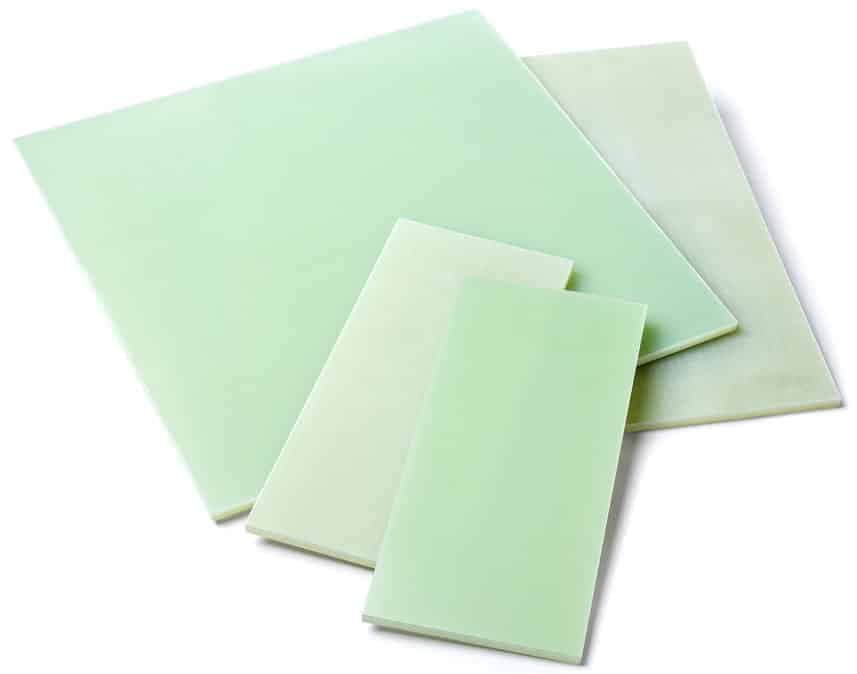
Laminated sheets are made of a substrate such as fiberglass cloth, carbon fiber cloth, canvas, linen or paper combined with a resin. Phenolic, epoxy, melamine or polyester resins are used in the prepreg process, and the prepreg is pressed under high heat and pressure to form a thermoset laminate. Phenolic sheet (paper, canvas or linen with phenolic resin) and glass-epoxy sheet such as G-10/FR-4 are the most common. These sheets have a multitude of uses across industrial, automotive, testing, medical, sports and many other industries.
Industrial:

A full-size sheet is often fabricated into other parts such as bushings, gears, bearings or spacers. These parts go into welding machines, oil and gas equipment and other insulation needs, where they provide the strength and insulation the application requires. Canvas phenolic sheet is the classic choice for gears and bearings; paper phenolic sheet for insulating washers and terminal boards. The material can be processed by CNC machining, laser cutting or waterjet cutting to create precise parts. Sheets can also be cut into small, thin panels for printed circuit boards, or large, thick panels used as wear plates in steel mills, which withstand substantial wear and tear.
Automotive:

Very thin sheets of G-10/FR4 are used under the dashboard in cars and helicopters to separate electrical components. Laminated carbon fiber is also used for interior design in automobiles; carbon fiber is available in plain, twill and patterned weaves. A block of canvas phenolic can be machined into a carburetor riser, while thin carbon fiber sheets are machined into reed valves for snowmobiles and motorcycles, parts that last an amazingly long time. Laminated sheets are also used as backing plates to mount hardware in boats.
Testing:

G-10/FR4 and G-11/FR5 are well suited to electrical environments because of their dielectric insulating properties. They are also used in labs: thin sheets of G-10 are a component in vibration testing, and a static-dissipative coating on G-10 provides static-controlled surfaces for electrical testing.
Medical:

One medical use is in stethoscopes, whose flat diaphragm is a thin, rigid disk of epoxy fiberglass. Another is in X-ray and MRI machines, where a plate of epoxy-based carbon fiber under the bed supports the patient.
Sports:

Laminated sheets can be made in many colors and layered or burled into unique patterns, which makes them a decorative material for knife handles and gun grips. G-10, G-11, carbon fiber, canvas, linen and paper laminates are all used this way. Carbon fiber is also used as thin tubes for hunting arrows, and thicker carbon fiber tubes make up the frame of pop-up hunting blinds.
Choosing a Sheet Grade
A quick rule of thumb: paper phenolic (X, XX, XXX) for low-cost electrical insulation, canvas and linen phenolic (C, CE, L, LE) for tough machined mechanical parts, G-10/FR-4 for the highest strength and best electrical properties, G-11/FR-5 when the part runs hot, and carbon fiber when weight matters most. The properties comparison gives the NEMA figures for every grade.
Conclusion
These five applications for laminated sheets are only a handful of the ways to use them. Sheets are versatile enough to serve as large panels or be machined into application-specific parts, and the substrates and resins behind them make very strong products that last a long time in almost any environment. We make laminated and phenolic sheet in standard 36″ × 48″ and 48″ × 96″ sizes, cut to size on request.