
G10 and FR4 are two names you will see on almost every drawing that calls for a strong, insulating, glass-reinforced plastic. They are closely related, often used interchangeably, and not quite the same thing. This guide explains what G10 material is made of, how G-10 and FR-4 differ, what the numbers look like, and how to choose. It was first published in 2021 and updated in 2026.
A History of G-10 and FR-4
G-10 is a thermosetting industrial laminated plastic made of woven glass cloth in an epoxy resin matrix. First introduced in the 1950s, G-10 was the original glass-epoxy laminate used in printed circuitry. Its high strength, excellent electrical properties and chemical resistance make it a very versatile material that is now used in a wide variety of applications.
Today most of what is called G-10 is actually FR-4, the flame-retardant version of G-10. That is why you will also see the material designated G-10FR, which means FR-4. FR-4 can usually be used where G-10 is called out; G-10 should not be used where FR-4 is specified.
What Is G10 Material Made Of?
G10 is made of two things: layers of continuous-filament woven glass fabric, and an epoxy resin that binds them. The glass cloth is impregnated with resin, partially cured into a "prepreg", stacked to the thickness required and pressed under heat and high pressure until the resin fully cures. The result is a dense, homogeneous sheet, tube or rod that cannot be melted again, which is what "thermoset" means.
FR-4 is made the same way with a flame-retardant epoxy system, which typically contains bromine. For applications that must avoid halogens, non-brominated G-10 uses the same glass and an epoxy without halogenated flame retardants. You may also know G10 by the trade name Garolite, which some distributors use for the same material.
What Is G-10?
G-10 is a NEMA grade thermoset laminate of epoxy resin and woven fiberglass. It is suited to applications that need electrical insulation and very high mechanical strength at room temperature. Variants are noted by suffix: G-10/CR for cryogenic service and G-10/FR4 for flame-retardant. G-10 is covered by MIL-I-24768/2 (Type GEE).
What Is FR4?
FR4 is G-10 glass-epoxy laminate with flame-retardant properties, rated at least Class I under NEMA test method 7.11. It is the material of choice for electronics and wherever fire performance is a design consideration, and it is the standard substrate for printed circuit boards and copper clad laminate. FR-4 withstands continuous heat up to about 140 °C, has excellent electrical insulating properties and performs in both dry and humid conditions. It is covered by MIL-I-24768/27 (Type GEE-F) and IPC-4101/21 and /23.
G10 vs FR4: How Do They Compare?
At room temperature the two are mechanically the same material. The difference is fire performance, and it decides which way you can substitute:
- FR-4 can replace G-10. It meets or exceeds G-10 on strength and adds flame retardance.
- G-10 cannot replace FR-4. Plain G-10 is not flame retardant, so it cannot be used where a drawing or a safety standard specifies FR-4.
- Neither is for high heat. For continuous service above FR-4's range, step up to G-11 or FR-5, which keep at least half their flexural strength at 150 °C. See G-10 vs G-11 for the details.
G10 Material Properties
NEMA sets minimums and maximums for each grade, measured on 0.500-inch sheet. For G-10/FR-4:
| Property (NEMA, 0.500 in sheet) | G-10 / FR-4 |
|---|---|
| Flexural strength, lengthwise (min.) | 45,000 psi |
| Flexural strength, crosswise (min.) | 35,000 psi |
| Izod impact, lengthwise (min.) | 7.0 ft-lb/in |
| Breakdown voltage (min.) | 45 kV |
| Permittivity at 1 MHz (max.) | 5.2 |
| Dissipation factor at 1 MHz (max.) | 0.025 |
| Bonding strength (min.) | 2,000 lb |
| Water absorption (max.) | 0.10% |
Those numbers explain where G10 is used: roughly three times the flexural strength of canvas or linen phenolic, very low water absorption, and a high breakdown voltage. The properties comparison puts every grade side by side, and the grades chart lists each MIL-I-24768 slash sheet.
How Strong Are These Materials?
Strength depends on the thickness of the material and on the application, but as the table shows, G-10/FR-4 is one of the strongest laminates in bending and impact. It is also very stable dimensionally, which is why it is machined into precision spacers and standoffs, insulators and structural parts.
What Is G10 Used For?
- Printed circuit boards and PCB test fixtures
- Electrical insulation: transformer and switchgear parts, terminal boards, arc barriers
- Mechanical parts: bushings, washers, brackets and wear parts
- Knife handles and gun grips, where the color range and grip texture matter as much as strength
- Cryogenic supports and insulators (G-10/CR)
How Long Does G-10/FR4 Last?
It depends on where it is used. Out of sunlight it lasts almost indefinitely: inside machinery, structures or vehicles, a piece of G-10 is effectively permanent. Outdoors it slowly degrades over a period of years, because it has no UV protection and sunlight gradually breaks down the resin at the surface.
What Colors Is G-10 Material Available In?
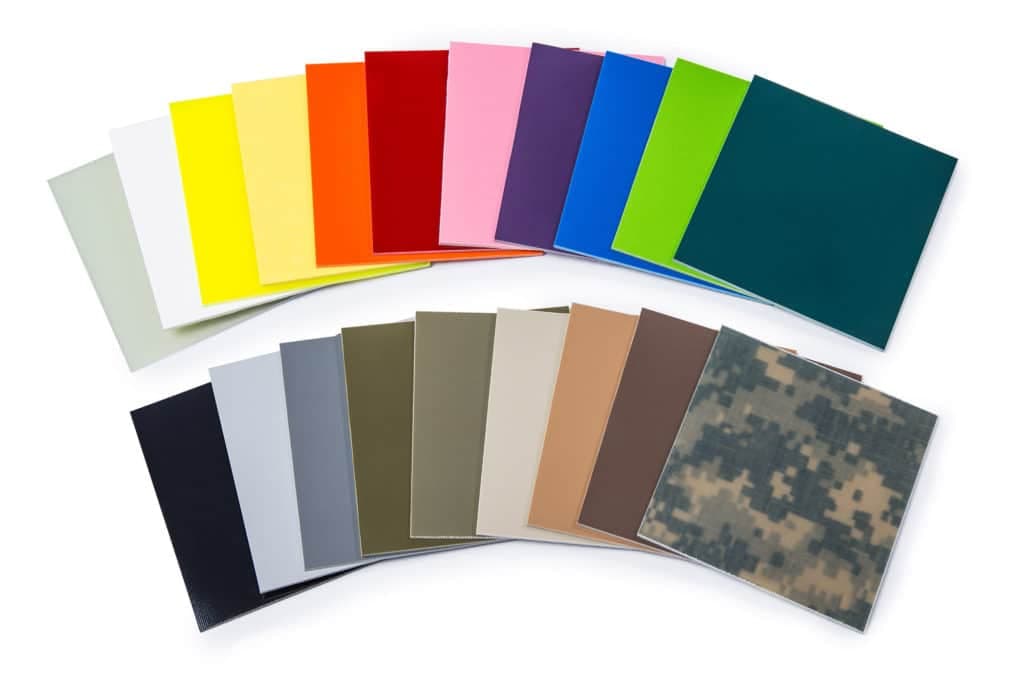
The natural color is a jade green. We have developed 21 colors in FR-4, including red, blue, black, white, orange, tan, ivory, purple, pink, several greens and greys, and a DayGlo color that glows in the dark. Keep an eye on our What's New page for new product and color releases.
Sizes and Forms
We make G-10/FR-4 as sheet, tube and rod. Standard G10 sheets are 36″ × 48″ and 48″ × 96″, from 0.005″ to 3.000″ thick, with cut-to-size and sanding available. Tubes run from 0.375″ to 4.000″ ID. For machined parts, see how to machine G-10 or send us your drawing through custom fabrication.
What Is the Future of This Material?
The sky is the limit for G-10/FR4. Its future is in the hands of the designers and engineers who specify it, and it keeps finding new uses in advanced technology, from electric-vehicle insulation to cryogenic hardware. If you are specifying it for a new part, send us the details and we will help you choose the right grade.