
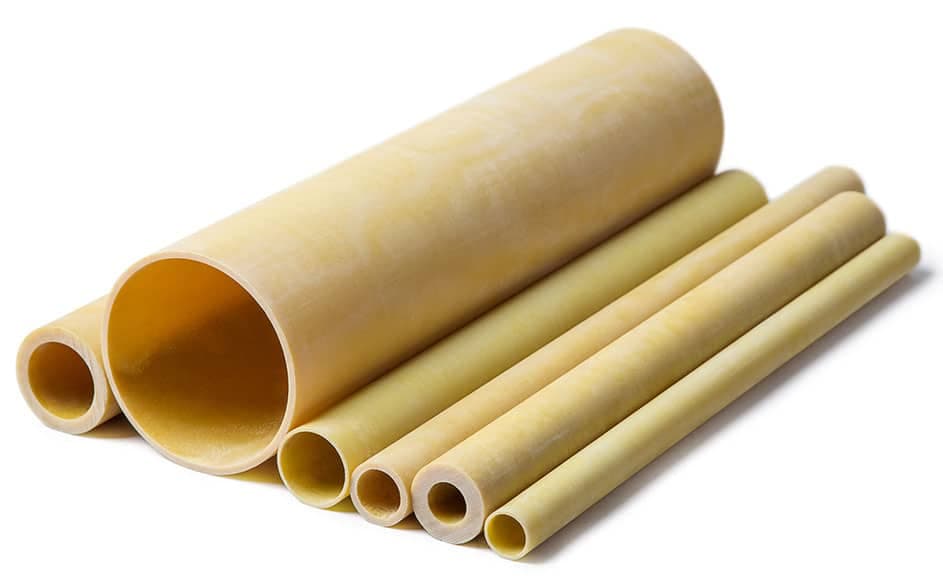
Introduction to Laminated Tubing
Laminated tubing is made from thermosetting resins (phenolic, epoxy or melamine) combined with base materials such as cellulose paper, woven cotton cloth or glass cloth. The materials are convolutely wound around a mandrel under heat and pressure, and the tube cures into a dense, uniform material. The same process gives phenolic tubing, canvas and linen tube (often called Micarta tube), and G-10 glass-epoxy tube (G10 tubes, also sold as Garolite tubing).
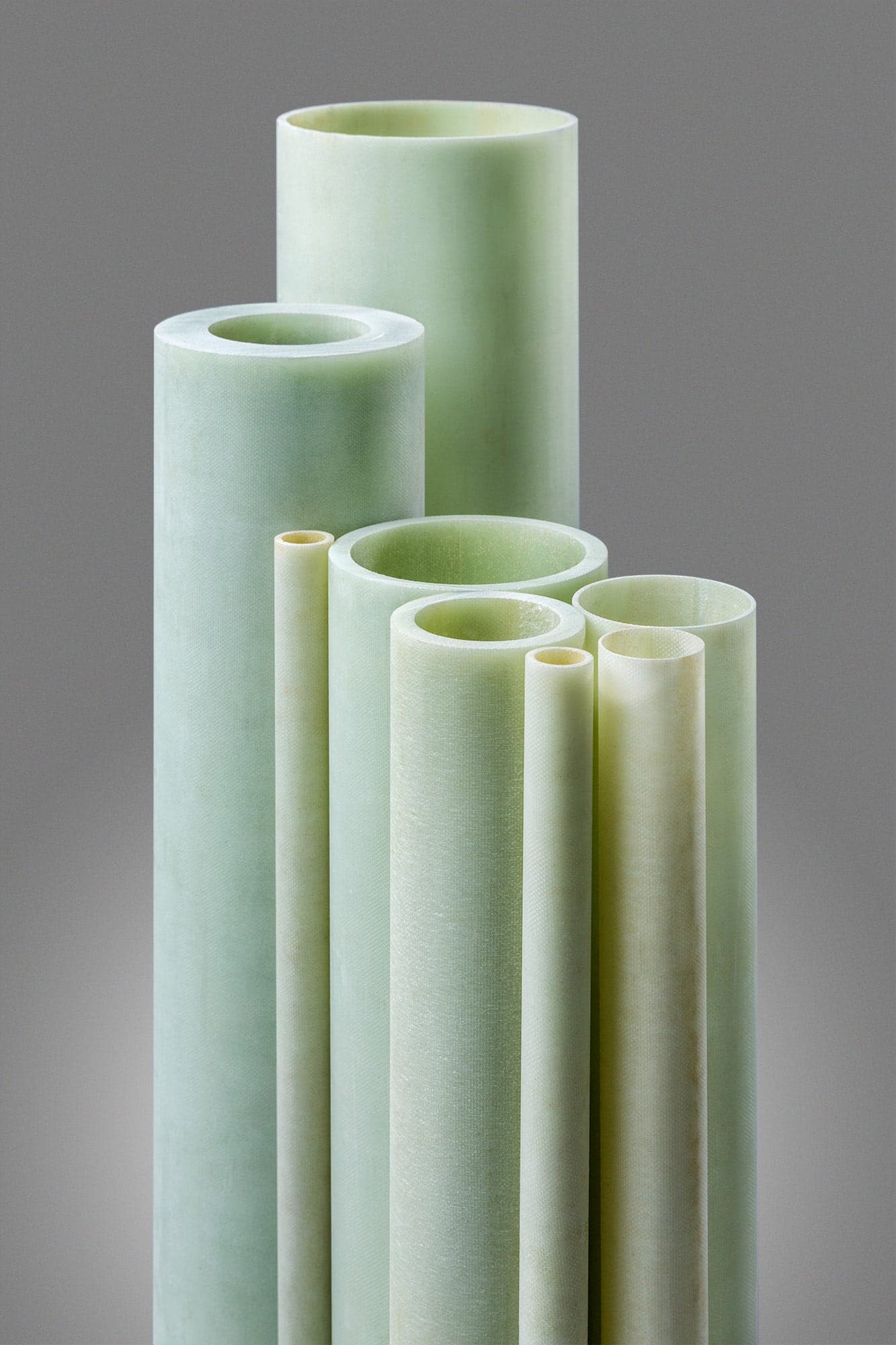
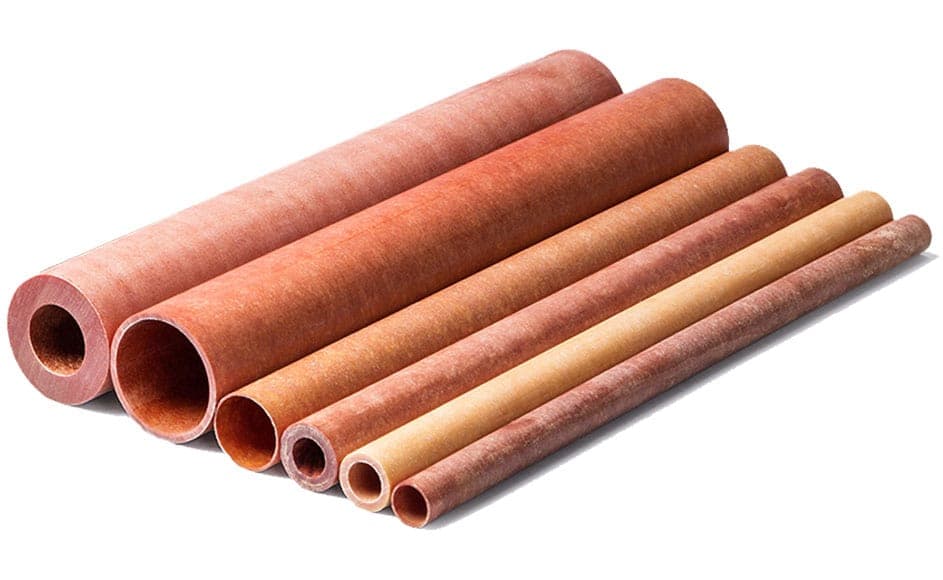
Laminated tubing is easy to work: it can be machined, polished, painted and printed on, and cut, drilled, tapped, threaded and punched with standard tools. It is an outstanding electrical insulator, and in many uses it is lighter, more durable and more economical than metal.
Composition and Manufacturing of Laminated Tubing
Materials
Laminated tubes pair a resin with a reinforcement, each chosen for what the tube has to do:
- Phenolic: good mechanical strength, heat resistance and insulation at an economical price. With paper it gives the XX and XXX grades; with cotton canvas or linen it gives the tougher CE and LE grades.
- Epoxy: Epoxy resins bond to glass cloth to give G-10/FR-4 and G-11/FR-5, the strongest tubes, with excellent electrical properties and very low moisture absorption.
- Melamine: with glass cloth, melamine gives G-5 and G-9, which are arc resistant, heat resistant and self-extinguishing.
Manufacturing Process
The reinforcement (paper, canvas, linen or glass cloth) is impregnated with resin and dried. It is then convolutely wound onto a steel mandrel under high pressure and heat, which binds the layers into a dense, homogeneous tube with high structural integrity. After curing, the mandrel is extracted and the tube is ground, cut to length and finished.
| G R A D E S | ||||||
| XX | Canvas Electrical Grade (CE) | Linen Electrical Grade (LE) | G-5, G-9 | G-10/FR4 | G-11/FR5 | |
| Features | Electrical insulation, high humidity resistance, good dimensional stability, good machining. | Good acid resistance, low voltage, low frequency electrical performance, high impact strength, good mechanical properties. | High mechanical and electrical strength, good appearance, good machining qualities, moisture resistance. | High mechanical strength, high arc and heat resistance, self extinguishing, excellent electrical properties under dry and humid conditions. | High flexural, impact and bond strength at room temperatures, good electrical properties under dry and humid conditions. | High mechanical strength at temperatures up to 150°C, self extinguishing, retains 50% of its flexural strength at elevated temperatures. |
| Interior Diameters – Sizes other than standard can be furnished on request | 0.187″ – 4.000″ | 0.187″ – 4.000″ | 0.187″ – 4.000″ | 0.375″ – 4.000″ | 0.375″ – 4.000″ | 0.375″ – 4.000″ |
| Tolerance | Below 1″, ID +/-0.003″, OD +/- 0.005″ Above 1″, ID +/- 0.005″, OD +/- 0.008″ | Below 1″, ID +/-0.003″, OD +/- 0.005″ Above 1″, ID +/- 0.005″, OD +/- 0.008″ | Below 1″, ID +/-0.003″, OD +/- 0.005″ Above 1″, ID +/- 0.005″, OD +/- 0.008″ | Below 1″, ID +/-0.003″, OD +/- 0.005″ Above 1″, ID +/- 0.005″, OD +/- 0.008″ | Below 1″, ID +/-0.003″, OD +/- 0.005″ Above 1″, ID +/- 0.005″, OD +/- 0.008″ | Below 1″, ID +/-0.003″, OD +/- 0.005″ Above 1″, ID +/- 0.005″, OD +/- 0.008″ |
| Length | 36″- 48″ RL (Minimum length dependent on mandrel availability) | 36″- 48″ RL (Minimum length dependent on mandrel availability) | 36″- 48″ RL (Minimum length dependent on mandrel availability) | 36″- 48″ RL (Minimum length dependent on mandrel availability) | 36″- 48″ RL (Minimum length dependent on mandrel availability) | 36″- 48″ RL (Minimum length dependent on mandrel availability) |
| Color | Natural Black (Other colors available upon request) | Natural Black (Other colors available upon request) | Natural Black (Other colors available upon request) | Natural color only. | Natural Black (Other colors available upon request) | Natural color only. |
| Specifications | MIL-I-24768/10 Type PBE MIL-I-24768/11 Type PBG MIL-I-24768/12 Type PBM | MIL-I-24768/14 Type FBG MIL-I-24768/16 Type FBM | MIL-I-24768/13 Type FBE MIL-I-24768/15 Type FBI | MIL-I-24768/01 Type GME MIL-I-24768/08 Type GMG | MIL-I-24768/02 Type GEE MIL-I-24768/27 Type GEE-F | MIL-I-24768/28 Type GEB-F |
Properties and Advantages
- High Mechanical Strength: Wound under pressure, laminated tubes are strong and rigid, and the glass-epoxy grades are among the strongest insulating tubes made.
- Thermal Resistance: Phenolic, melamine and epoxy tubes hold their shape and strength at elevated temperatures; G-11/FR-5 keeps at least half its flexural strength at 150 °C.
- Electrical Insulation: Every grade is an insulator, which makes laminated tubing a standard material for coil forms, fuse tubes and insulating sleeves.
- Chemical and Moisture Resistance: The thermoset resins resist oils, many solvents and moisture; XXX and the glass grades are chosen for humid conditions.
- Dimensional Stability: Tubes keep their size and shape across a range of temperatures and loads, so they can be machined to close tolerances.
- Standards Compliance: Our tubing is made to NEMA grades and the MIL-I-24768 specifications listed in the table above.
Choosing a Tube Grade: Phenolic, Micarta or G-10
- Paper phenolic tube (XX, XXX) for economical electrical insulation: coil forms, fuse tubes, bobbins.
- Canvas and linen phenolic tube (CE, LE), the material sold as Micarta tube, for tough mechanical parts with a machined finish: bushings, rollers, handles.
- G-10/FR-4 tube, often sold as Garolite tube, for the highest strength and best electrical properties.
- G-11/FR-5 tube when the part runs hot, and G-5/G-9 when arc resistance matters.
If you need stiffness at the lowest weight rather than insulation, look at our carbon fiber tubes instead.
The Diverse Range of Laminated Tubes by CURRENT, INC
Over the years Current has seen its tubing used in countless applications, and new ones keep arriving.
Our laminated tubing comes in lengths from 36″ to 48″, inside diameters from 0.187″ (phenolic) and 0.375″ (glass) up to 4″, and outside diameters up to 5″. Larger sizes are quoted on request. Finishes include ground and polished, tailored to your requirements.
Laminated Tubes Applications and Lengths At Current Inc
Laminated tubing goes into a wide range of industries. Some common uses:
- Coil forms and bobbins
- Fuse tubes and insulating sleeves
- Rollers, including window shade and copy machine rollers
- Welding and probe handles
- Antenna bases and housings for circuitry
- Sleeve bearings, shoulder bushings and thrust washers
- Standoffs for printed circuit boards
- Telescope tubes and liners
How to Order Laminated Tubing
To quote a tube we need:
- The grade, or what the tube has to do (insulate, carry load, run hot, resist arcing).
- Inside diameter, outside diameter or wall, and length, with tolerances.
- Finish and color, if they matter.
- Quantity, and whether you need plain tube or machined parts.
Contact us by email, phone or the form below; quotes are free and carry no obligation. Our step-by-step guide on how to order or request a quote walks through the rest.
About CURRENT, INC.
Founded in 1962, Current has always been a family-owned business, and all of our tubing is wound in the USA. Every tube is checked for quality and accuracy before it ships, and our office staff will answer any questions, and find the answer if they do not have it immediately.

Thank you for considering Current as your supplier of high-performance laminated tubing.