
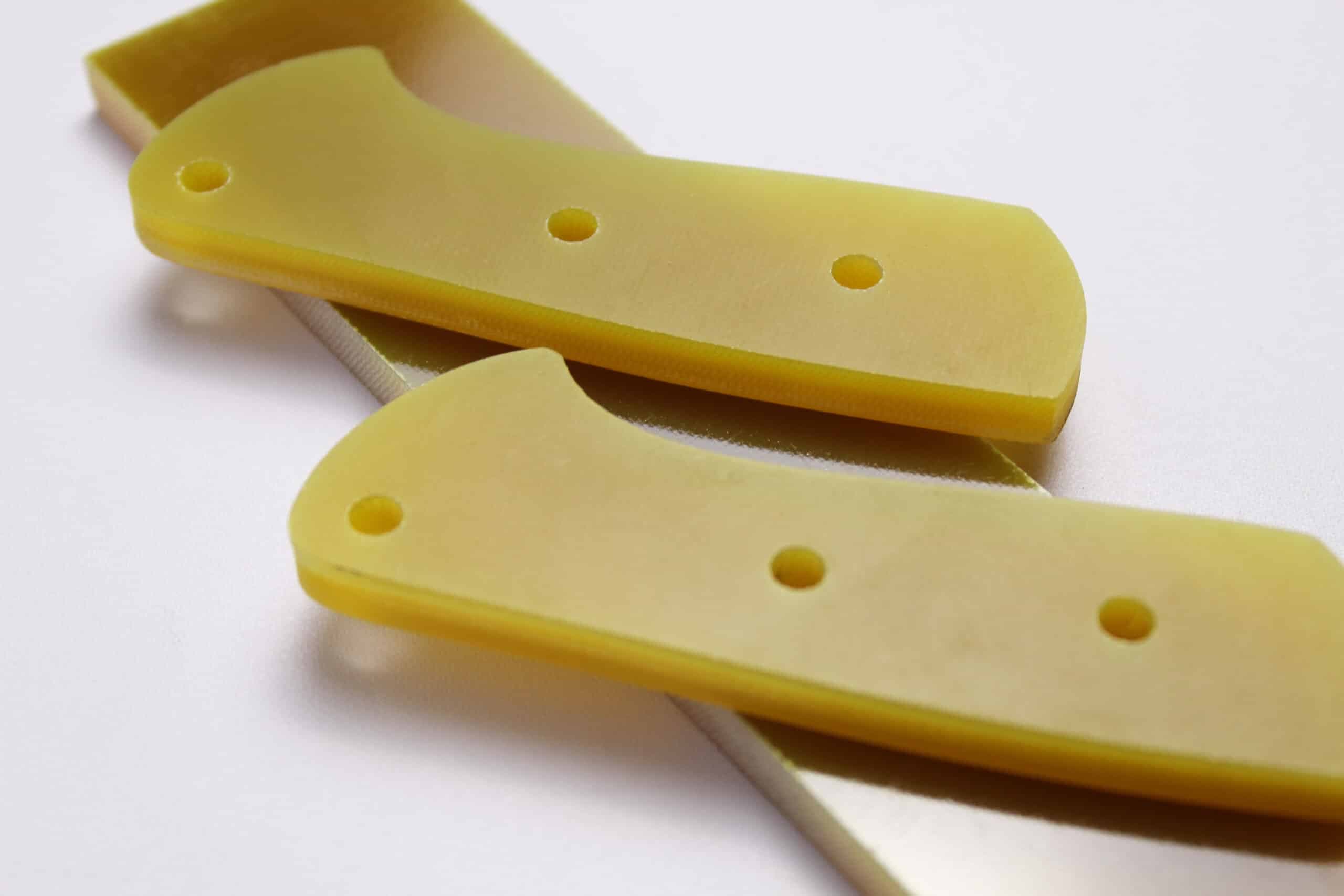
G-10 and G-11 (often written G10 and G11) look alike, machine alike and, at room temperature, test alike. Both are woven glass cloth in an epoxy resin, pressed under heat and pressure. The difference is the resin system: G-11 is formulated to keep working when the part gets hot. If you have ever wondered why a drawing calls out G-11 for a part that seems like an ordinary G-10 job, the answer is almost always temperature.
The same numbers at room temperature
Per NEMA, on 0.500-inch sheet, the two grades are hard to tell apart:
| Property (NEMA, 0.500 in sheet) | G-10 / FR-4 | G-11 | FR-5 |
|---|---|---|---|
| Flexural strength, lengthwise (min., ×1000 psi) | 45.0 | 45.0 | 45.0 |
| Flexural strength, crosswise (min., ×1000 psi) | 35.0 | 35.0 | 35.0 |
| Izod impact, lengthwise (min., ft-lb/in) | 7.0 | 7.0 | 7.0 |
| Breakdown voltage (min., kV) | 45.0 | 45.0 | 45.0 |
| Permittivity at 1 MHz (max.) | 5.2 | 5.5 | 5.2 |
| Dissipation factor at 1 MHz (max.) | 0.025 | 0.025 | 0.025 |
| Bonding strength (min., lb) | 2000 | 1600 | 1600 |
| Water absorption (max.) | 0.10% | 0.10% | 0.10% |
| MIL-I-24768 sheet | /27 | — | /28 |
Bonding strength is the one room-temperature figure where G-10 leads. Everything else is a wash.
The difference is heat
G-10 has high flexural, impact and bond strength at room temperature and good electrical properties in dry and humid conditions. G-11 keeps high mechanical strength at temperatures up to 150 °C and retains 50% of its flexural strength at elevated temperatures, where G-10 has already softened. It is self-extinguishing as well.
In practice that means: a G-10 bracket that sits next to a heater, a motor winding, a transformer core or a hot process line will creep and lose stiffness over time; the same bracket in G-11 will not. Insulators, spacers, terminal boards and structural parts that run warm are where G-11 earns its premium.
FR-4 and FR-5: the flame-retardant versions
FR-4 is the flame-retardant grade of G-10 and FR-5 is the flame-retardant grade of G-11. Most G-10 sold today is actually FR-4 (it can be used where G-10 is called out, but not the other way round). FR-5 gives you the high-temperature performance of G-11 with a flame rating, which is why it appears on drawings for switchgear and aerospace hardware. We make copper clad FR-5 for circuit boards that must hold their flexural strength at 177 °C.
A simple rule
- Part runs at room temperature, or briefly warm: G-10 / FR-4. Lower cost, higher bond strength, more colours.
- Part runs hot continuously (toward 150 °C) or carries load at temperature: G-11 / FR-5.
- Drawing calls out a MIL-I-24768 sheet: /27 is FR-4, /28 is FR-5; use what is specified.
- Halogen-free requirement: neither; ask for non-brominated G-10.
Sizes, colours and datasheets are on the G-10 / FR-4 page and the G-11 / FR-5 page. The full NEMA table for every grade we press is on the properties comparison.
Can I substitute G-11 for G-10?
Mechanically and electrically, yes: G-11 meets or exceeds G-10 at room temperature except for bonding strength. It costs more, so substitute only when heat is the reason.
Does G-11 machine differently?
No. Both are glass-filled epoxy and machine with the same tooling and feeds. Both are hard on tooling compared with phenolic.
What is the maximum service temperature of G-10?
NEMA does not publish a single number; the practical guidance is that G-10 is a room-temperature grade and G-11 is the grade rated for continuous service up to 150 °C. Tell us the operating temperature and we will recommend the grade.