
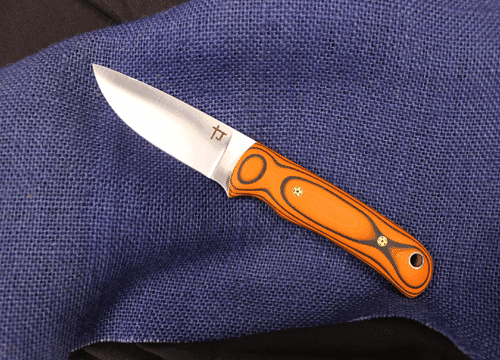
G-10 and Micarta are the two laminates knife makers reach for most, and "G10 vs Micarta" is one of the first questions a new maker asks. They are made the same way, on the same kind of press, and we make both in East Haven, Connecticut. The difference is what goes into the press: glass cloth and epoxy for G-10, cotton canvas or linen and phenolic resin for the material most people call Micarta. That difference decides how each one feels, machines, wears and looks.
What each material is
G-10 is woven glass cloth impregnated with epoxy resin and cured under heat and pressure. Most G-10 sold today is FR-4, the flame-retardant version; the two machine and finish the same way. It is often written G10, and sold under the trade name Garolite.
Micarta is a brand name that has become shorthand for phenolic laminates: cotton canvas (NEMA grade C or CE) or fine-weave linen (NEMA grade L or LE) impregnated with phenolic resin and pressed the same way. Canvas gives a coarser, more textured face; linen is finer and takes closer detail.
The numbers, per NEMA
These are NEMA minimums and maximums for 0.500-inch sheet, the same figures on our properties comparison.
| Property (NEMA, 0.500 in sheet) | G-10 / FR-4 | Canvas CE | Linen LE |
|---|---|---|---|
| Flexural strength, lengthwise (min., ×1000 psi) | 45.0 | 15.5 | 15.0 |
| Izod impact, lengthwise (min., ft-lb/in) | 7.0 | 1.60 | 1.25 |
| Water absorption (max.) | 0.10% | 0.75% | 0.70% |
| Breakdown voltage (min., kV) | 45.0 | 35.0 | 40.0 |
| Bonding strength (min., lb) | 2000 | 1800 | 1600 |
| MIL-I-24768 sheet | /27 | /14 | /13 |
Read across the first three rows and the story is clear: G-10 is roughly three times as strong in bending, several times tougher in impact, and absorbs a fraction of the water. That is why G-10 dominates hard-use and outdoor knives.
Where Micarta wins
- Feel. Canvas and linen phenolic have a warmer, slightly grippy hand, and they get grippier when wet. Many makers and users prefer it to the harder, slicker face of G-10.
- Finish. Sanded or bead-blasted phenolic shows the cloth texture; polished, it takes on a deep look that ages well. It can be textured in ways G-10 cannot.
- Machining. Both machine well, but glass-filled G-10 is harder on tooling than cotton-filled phenolic. Phenolic is kinder to files and belts in a small shop.
- Classic look. Linen and canvas phenolic are the traditional handle materials on production knives and tools going back decades.
Where G-10 wins
- Strength and toughness. The figures above.
- Water. A tenth of a percent absorption means G-10 scales stay dimensionally stable in wet use; phenolic swells slightly.
- Colour. We press G-10 in more than twenty solid colours, plus layered and camo patterns that reveal stripes when contoured. Phenolic comes in the natural colours of the cloth and resin.
- Flame rating. FR-4 is self-extinguishing (NEMA Class I under test method 7.11), which matters for tools used near heat.
How to choose
- Hard use, wet use, bright colours: G-10.
- Traditional look, warm grip, texture: canvas (C/CE) or linen (L/LE) phenolic.
- Fine detail and close tolerances: linen over canvas.
- Both on one knife: makers often pair a G-10 liner with phenolic scales, or the reverse; ask us for liner stock.
Whichever you choose, the sheet comes off the same presses here. See the G-10 / FR-4 page, the canvas phenolic page and the linen phenolic page for sizes and datasheets, or the knife handle materials page for the whole range including Liberty Wood.
Is Micarta a specific material?
Micarta is a trade name. The generic materials are NEMA grade C and CE (canvas phenolic) and L and LE (linen phenolic). Ours are pressed to those NEMA grades and to the matching MIL-I-24768 slash sheets.
Is G-10 the same as FR-4 and Garolite?
FR-4 is the flame-retardant version of G-10 and is what most G-10 sold today actually is. Garolite is a trade name for the same glass-epoxy laminate.
What thicknesses do handle scales use?
Most scales are cut from 1/8, 3/16, 1/4 and 3/8 inch sheet. We press sheet from 0.005 to 3.000 inch and can sand to a thickness tolerance of ±0.005 inch.