
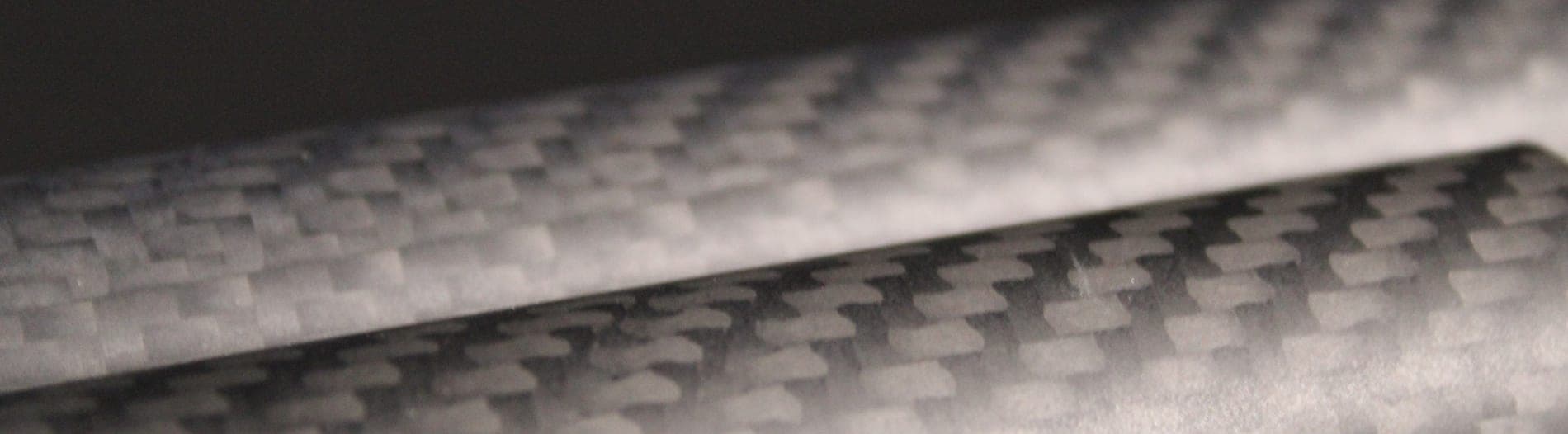
Carbon Fiber Tubes
Current, Inc. is a carbon fiber tube manufacturer in East Haven, Connecticut. We make carbon fiber tubes in-house, on the same floor as the phenolic and glass-epoxy tubing we have wound since 1962. Tubes are roll-wrapped from prepreg carbon fiber on precision mandrels, cured under controlled pressure and temperature, and extracted, sanded and cut to length before they ship.
How the tubes are made
Roll-wrapping lets us tailor three things independently for each job: wall thickness, inside and outside diameter, and fiber angle. Plies laid along the tube axis carry bending loads; plies at ±45° carry torsion. Balancing the two is what gives a drone arm, a telescope section or a paddle shaft the stiffness it needs without extra weight. That is the difference from a pultruded carbon fiber tube, whose fibers run only along its length: pultruded carbon tubes are stiff in bending but weak in torsion, while a roll-wrapped tube can be built for both.
- Material. 3K plain-weave and unidirectional prepreg carbon fiber, stored and laid up in a climate-controlled environment.
- Process. Hand layup on a mandrel, high-pressure cure cycle, mandrel extraction, surface finish, cut to length. Convolutely wound tube configurations run up to 12 feet long.
- Sizes. Inside and outside diameters start at 0.093 inch. Tell us the ID, OD and length you need and we will confirm what tooling we have on hand and what needs a new mandrel.
- Finish. Sanded, ground or polished, with a natural weave face or a painted or clear-coated surface.
- Secondary work. Precision cut-off, drilled holes, slots and bonded inserts, done alongside our 3-axis CNC milling for flat carbon parts.
Where they are used
Our custom carbon fiber tubes fly on FPV and defense drones as arms and load-bearing members, where we tuned wall and fiber angle to survive high-G manoeuvres. They go into sporting goods, from archery and paddle sports to fishing rod blanks and cycling components, and into telescopes, instruments, robotics and marine hardware where a metal tube is too heavy or corrodes.
Read how we produced flat parts and tubes for an FPV and defense drone platform on a compressed timeline, and see the wider range of carbon fiber sheets, rods and fabricated parts we make.
Carbon fiber tube or laminated tube?
Carbon fiber gives the highest stiffness-to-weight ratio. When the job needs electrical insulation, arc resistance or a lower price point, a phenolic or G-10 laminated tube is often the better fit. We make both, so we can quote the right one.
How to specify a tube
- Inside diameter, outside diameter (or wall) and length, with tolerances if they matter.
- What the tube has to do: the bending load, torque or pressure, and the environment.
- Quantity, whether this is a prototype or production, and the date you need it.
- Surface finish and any machining, holes or inserts.
Send that with any drawing to the form below or to [email protected] and you will have a quote promptly and at no obligation.
FAQs
Are carbon fiber tubes made in the USA?
Yes. Every tube is roll-wrapped, cured and finished in our East Haven, Connecticut plant.
What diameters can you make?
Inside and outside diameters start at 0.093 inch and run up through the large-bore sizes we wind for industrial tubing. Convolutely wound configurations go up to 12 feet long. Non-standard sizes are quoted on request.
Can you match a tube to a drawing or a competitor's part?
Yes. Send the drawing or the part; we confirm mandrel availability, layup and finish, then quote.
Do you also make flat carbon fiber parts?
Yes. Plates are pressed from prepreg and machined on 3-axis CNC alongside the tubes, so complete assemblies ship from one source.
Read More From Our Blog

A Guide to Laminated Tubing & How to Order USA Made
Laminated tubing is made from thermosetting resins (phenolic, epoxy or melamine) combined with base materials such as cellulose paper, woven cotton cloth or glass cloth.
more »
How Composites and Laminates are Used in the Knife & Weapon Industry
Knife and weapon handles have to be tough, stable, grippy and good-looking at the same time, and composite laminates do all four better than most natural materials.
more »
How Composites and Laminates are Used in the Marine Industry
Boats are hard on materials. Salt water corrodes metal, wood swells and rots, and everything on board takes vibration, UV and constant wetting.
more »