
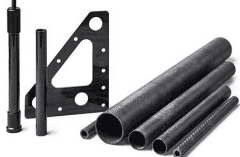
Carbon fiber sheet and plate
Current, Inc. presses carbon fiber sheet and plate in-house from prepreg fabric, in the same climate-controlled layup and curing environment we use for the flat parts on our drone and defense work. Plates are cured under pressure and temperature, inspected, and either shipped as sheet or moved straight to our 3-axis CNC mills to be cut to your drawing.
Weaves and fabrics
The face weave changes how a sheet looks, how it drapes during layup and how it carries load. We stock and lay up the common styles:
- Plain weave (3K is the standard): fibers interlock alternately over and under. Good stability, the classic checkerboard face, ideal for flat panels and minimal contour radius.
- Twill (2×2, 3×3, 4×4): the diagonal "twill line" face. Very pliable with excellent drape while keeping stability.
- Satin (four, five or eight harness): tows float over several intersections and interlock under one, so the fabric drapes easily over difficult shapes.
- Basket weave: multiple warp ends and fill tows woven together for heavier fabrics.
- Unidirectional tape: all fibers in one direction, for stacking plies at chosen angles when the load is directional.
Weaves include unidirectional, 3K plain, 3K 2×2 twill, 6K, 12K and more. Tell us the look you need on the show face and the loads the part carries; we choose the layup.
How to specify sheet or plate
- Thickness and sheet size, or the finished part drawing if we are machining it.
- Face weave and finish: natural weave under clear epoxy, matte or gloss.
- Layup: symmetric quasi-isotropic for general stiffness, or oriented plies if the part bends or twists one way.
- Quantity, prototype or production, and the date you need it.
Standard sheet thicknesses and sizes are quoted per order; send your requirement to the form below or to [email protected].
Machined parts from sheet
Because plate and machining are under one roof, a set of brackets, mounting plates, electronics bays or structural plates goes from digital file to finished parts without a vendor hand-off. Our 3-axis milling cells are dedicated to composites, so tooling and dust control are set up for carbon fiber. See the FPV and defense drone case study for a run that combined plates, machining and roll-wrapped tubes.
Carbon fiber sheet or laminated sheet?
Carbon fiber gives the highest stiffness-to-weight ratio and a distinctive face. When the part needs electrical insulation, arc resistance, colour or a lower price, a G-10/FR-4 or phenolic laminated sheet is often the better answer. We make both and will quote the right one.
FAQs
Is carbon fiber sheet made in the USA?
Yes. Plates are laid up, cured, inspected and machined in our East Haven, Connecticut plant.
What thicknesses can you make?
Thickness is set by the number of plies, so it is quoted per order. Send the thickness or the part drawing and we will confirm the layup.
Can you cut parts from the sheet?
Yes. Our 3-axis CNC mills cut flat parts to your drawing, and we can drill, slot and bond inserts.
Read More From Our Blog

A Guide to Laminated Tubing & How to Order USA Made
Laminated tubing is made from thermosetting resins (phenolic, epoxy or melamine) combined with base materials such as cellulose paper, woven cotton cloth or glass cloth.
more »
How Composites and Laminates are Used in the Knife & Weapon Industry
Knife and weapon handles have to be tough, stable, grippy and good-looking at the same time, and composite laminates do all four better than most natural materials.
more »
How Composites and Laminates are Used in the Marine Industry
Boats are hard on materials. Salt water corrodes metal, wood swells and rots, and everything on board takes vibration, UV and constant wetting.
more »